
If you deal with allergies, you know how important clean air is in your home. It can feel like every air purifier promises to clear your space, but many of those claims fall flat when it comes to real allergy relief. After years of testing over 100 different air purifiers for performance, sound, and energy use, I've found that only a few models truly deliver. Here's what actually matters when you're looking for an air purifier to help with allergies.
Key Takeaways
- For serious allergy relief, aim for at least six air changes per hour (ACPH) in your room.
- The air purifier needs to run under 45 decibels (dB) at its effective speed so you'll actually use it, especially at night.
- Most allergy sufferers only need a strong particle filter (like HEPA); activated carbon filters are for chemical sensitivities, not pollen or dust.
- Many small air purifiers are too weak for real allergy relief, despite what their marketing says.
- DIY options, like those using HVAC filters and PC fans, often offer the best balance of power, quiet operation, and affordability.
Why Most Air Purifiers Fall Short for Allergies
The biggest number to look for when you have allergies is air changes per hour (ACPH). This tells you how many times an air purifier can completely filter all the air in a specific room within one hour. Many air purifiers on the market claim to clean huge rooms, but they're often quoting that based on just one air change per hour. For allergies, that's like trying to bail out a sinking boat with a teaspoon. By the time it clears old pollen, a new batch of allergens has already floated in.
Industry experts, like the Association of Home Appliance Manufacturers (AHAM), suggest you need at least 4.8 ACPH for general air cleaning. For severe allergies, though, we recommend aiming for six air changes per hour. Six ACPH means the air in your room is cleaned of pollutants every 10 minutes – that's real relief.
Practically, this means many smaller air purifiers simply aren't up to the job. Take a popular model like the Levoit Core Mini. Its dust Clean Air Delivery Rate (CADR) is around 41 CFM (cubic feet per minute). To get six ACPH, that unit can only effectively clean a room about 51 square feet. That's barely a walk-in closet, not your bedroom.
Noise Levels Matter, Especially at Night
Even if an air purifier has a high CADR, it's useless if it's so loud you can't stand to run it. Allergies can be their worst at night, but who wants to sleep next to something that sounds like a jet engine? For example, the Molekule Air Mini+ at its top speed has a CADR of 96 CFM, which could give you six ACPH in a 120 sq ft room. The problem? It blasts out 67.4 dB of noise, louder than a vacuum cleaner. If you dial it down to a more livable 45 dB, its CADR plummets to just 36 CFM, making it effective for an even smaller room.
The Right Filter for Your Allergies
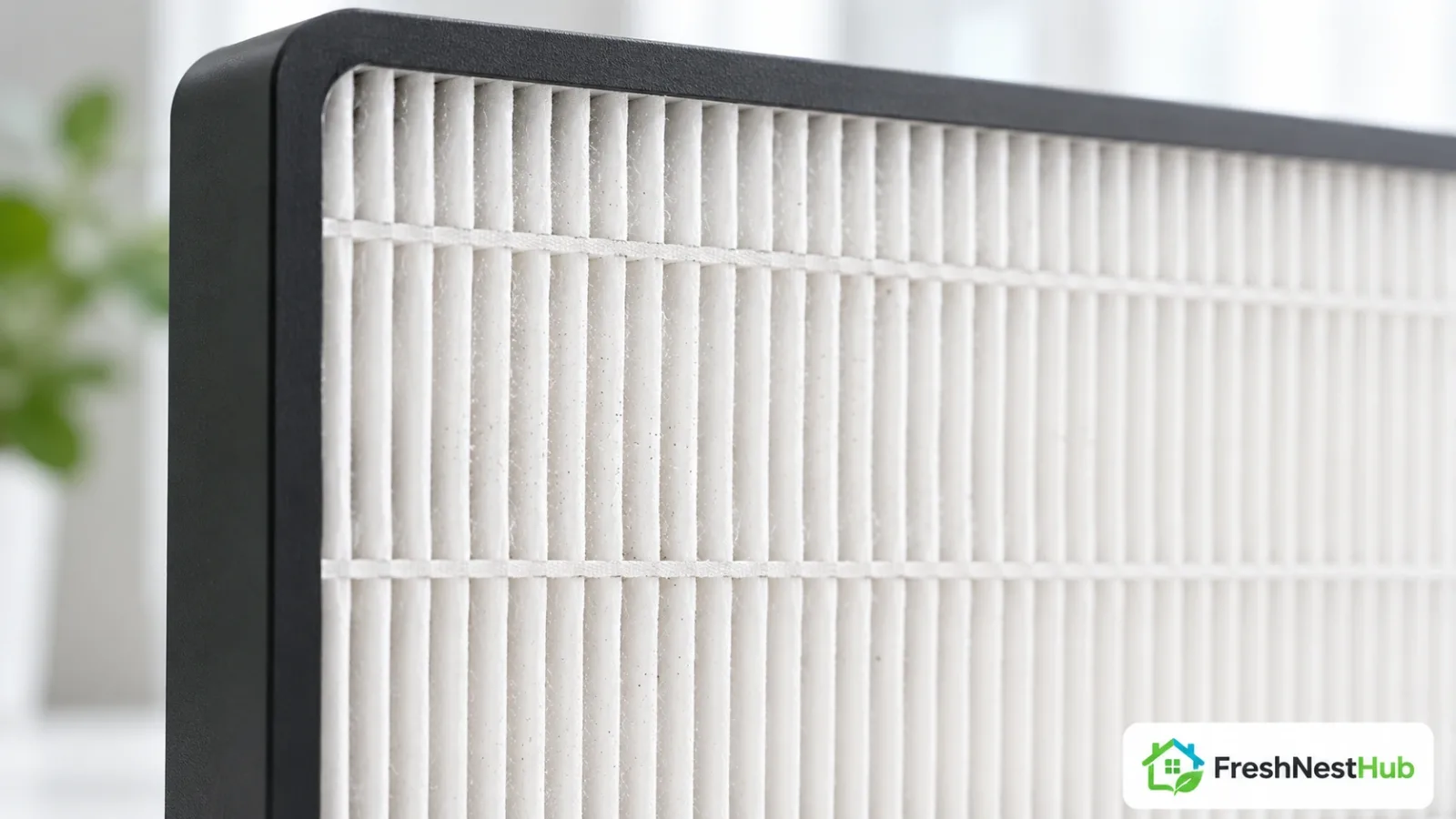
If you're allergic to common triggers like pollen, dust, or pet dander, you primarily need a device with an excellent particle filter, typically a HEPA filter. Activated carbon filters are only necessary if your allergies are tied to chemical sensitivities, like needing to remove cigarette smoke, perfumes, or new carpet smells.
The Magic Formula for Allergy Relief
So, the winning combination for most allergy sufferers is an air purifier that delivers six air changes per hour, runs under 45 dB, and has a solid particle filter.
Air Purifiers That Actually Deliver
After our extensive testing, these are the models that truly stand out for allergy sufferers:
Best Overall: Clean Air Kits Luggable XL7
This unique, PC fan-powered air purifier uses standard HVAC filters, making it a standout for incredible air cleaning performance at a whisper-quiet operation. The Luggable XL7 uses seven PC fans that pull air through two large 20x25 Merv 13 HVAC filters. This setup gives it a dust CADR of 323 CFM, providing six ACPH in rooms up to 403 square feet. The most impressive part? It does this at a mere 38.8 dB.
- Pros: Powerful, incredibly quiet, super energy efficient, and uses affordable, easy-to-find HVAC filters. The lack of a carbon filter means more airflow dedicated to particle removal.
- Cons: The body isn't as robust as traditional plastic or metal purifiers, and it's a large device.
Clean Air Kits offers options to address these cons, like the more durable Cherrywood Aring end table or a smaller 5-fan version. For those in Canada, Northbox Systems makes similar PC fan-powered HVAC filter purifiers. In Europe, check out the Nuke Tempest Jurro, which uses PC fans and IKEA filters, though it's a DIY kit you build yourself.
Best Under $200: Airfanta 3 Pro
If the Luggable XL7 is too big for your space, the Airfanta 3 Pro is a fantastic, budget-friendly option. At just under $160, it offers a top-speed CADR of 413 CFM. It's essentially a small box with filters on each side and a PC fan array on top.
- Pros: Excellent air cleaning at quiet sound levels. We found a fan speed under 45 dB that still delivers an estimated 213 CFM, outperforming much larger, more expensive units. It's also portable and can be disassembled and reassembled in minutes, making it great for travel. You can choose HEPA-only filters for higher CADR and lower cost.
- Cons: Filters are OEM (not standard HVAC), though prices are fair. It might not win beauty contests with its DIY look.
Best for Large Spaces: Coway Air Mega Pro X
If you need serious power for a big room and prefer a more traditional look, the Coway Air Mega Pro X is a top contender. It provides an estimated 299 CFM at sub-45 dB fan speeds, giving you six ACPH in spaces up to 373 square feet. At its top speed, it's the fastest HEPA air purifier we've tested, with an estimated 462 CFM, covering rooms up to 577 square feet for six ACPH.
- Pros: Exceptional power, includes an onboard air quality sensor and auto mode.
- Cons: It's not cheap (retailing over $800) and it's quite large and heavy (around 50 lbs).
Best for Small Spaces: Smart Air SA600
The Smart Air SA600 is a mid-size purifier with two sets of filters. Running at speed three, it generates just 41.5 dB. Based on our tests, it provides an estimated 128 CFM, which is enough for six ACPH in rooms up to 160 square feet.
- Pros: Quiet, effective for small-to-medium rooms, and uses non-bonded filters, so you can run it without the activated carbon filter if you don't need it, saving long-term costs. It can also be wall-mounted and automatically restarts after a power outage.
- Cons: No onboard sensor, auto mode, or app connectivity, but for some, this simplicity is a plus.
Other Options to Consider
Several other models came close but didn't quite make our top recommendations for various reasons:
- Smart Air Blast Mini: Powerful (272 CFM at speed 1), but the Coway Air Mega Pro X offers better performance at quieter levels and includes a sensor.
- IQAir Atom X: Provides 229 CFM at speed 4, but its high price tag (nearly $1,400) makes it hard to recommend over the Air Mega Pro X.
- Winix AM80 (or 0 in Europe): Often found for around $190, it delivers 134 CFM at 43.3 dB. It's not as powerful as the cheaper Airfanta 3 Pro, but could be an alternative to the Smart Air SA600.
- Levoit Vital 200S: A good performer under $200, but its raw air cleaning power at top speed isn't as good as the Airfanta 3 Pro.
- Dyson Big and Quiet BP06: The best Dyson air purifier we've tested, but its performance is comparable to models that cost a third of its price.
- Coway Air Mega 200M and AP-1512HH: While popular on other lists (like Wirecutter's), they are noisy at top speed (over 60 dB) and underpowered for meaningful cleaning at quiet fan speeds.
- Blueair Blue Pure 311i Max: Often under $200 with good performance at quiet speeds, but it forces you to use an ionization process that can't be disabled, which some prefer to avoid.
Finding the right air purifier for allergies means looking past the marketing and focusing on the numbers: high air changes per hour at a quiet sound level. With these recommendations, you can find a unit that truly makes a difference in your home's air quality without breaking the bank or your eardrums.

Comments
No comments yet — be the first.